Together, WooCommerce and Shopify power the vast majority of online stores worldwide. Both are capable platforms. The right choice for your business depends less on which platform is “better” and more on your technical resources, budget structure, and how much control you want over your store. Here is a practical, India-specific breakdown.
Two different approaches to the same problem
Shopify is a fully hosted SaaS platform. You pay a monthly subscription, and Shopify handles hosting, security, updates, and infrastructure entirely. WooCommerce is a free, open-source plugin that runs on WordPress. You own the code, choose your own hosting, and are responsible for managing everything yourself.
This single difference – rented infrastructure versus owned infrastructure – explains almost every other distinction between the two platforms, from cost structure to customisation to long-term flexibility.
Head-to-head comparison
| Factor | WooCommerce | Shopify |
|---|---|---|
| Upfront cost | Free plugin; real cost is hosting + plugins (₹15K–₹80K/year) | ₹2,500-₹25,000/month depending on plan |
| Setup time | 20-80 hours, or a developer at ₹4,000-₹8,000/hour | 2–8 hours; guided onboarding |
| Transaction fees | None – you choose your own payment gateway | 0.5-2% extra unless using Shopify Payments |
| Customisation | Full code access; 59,000+ WordPress plugins | Liquid templates; 8,000+ apps; checkout locked on lower plans |
| SEO control | Full control over URLs, schema, technical SEO | Strong basics; cannot remove /products/ URL prefix |
| Maintenance | Your responsibility – updates, security, backups | Handled entirely by Shopify |
| Best fit | Content-driven SEO, full ownership, complex catalogue | Fast launch, low technical overhead, in-person + online sales |
What this means for Indian SMEs specifically
For Indian SMEs, a few factors carry extra weight that don’t always show up in global comparisons.
Payment gateway flexibility
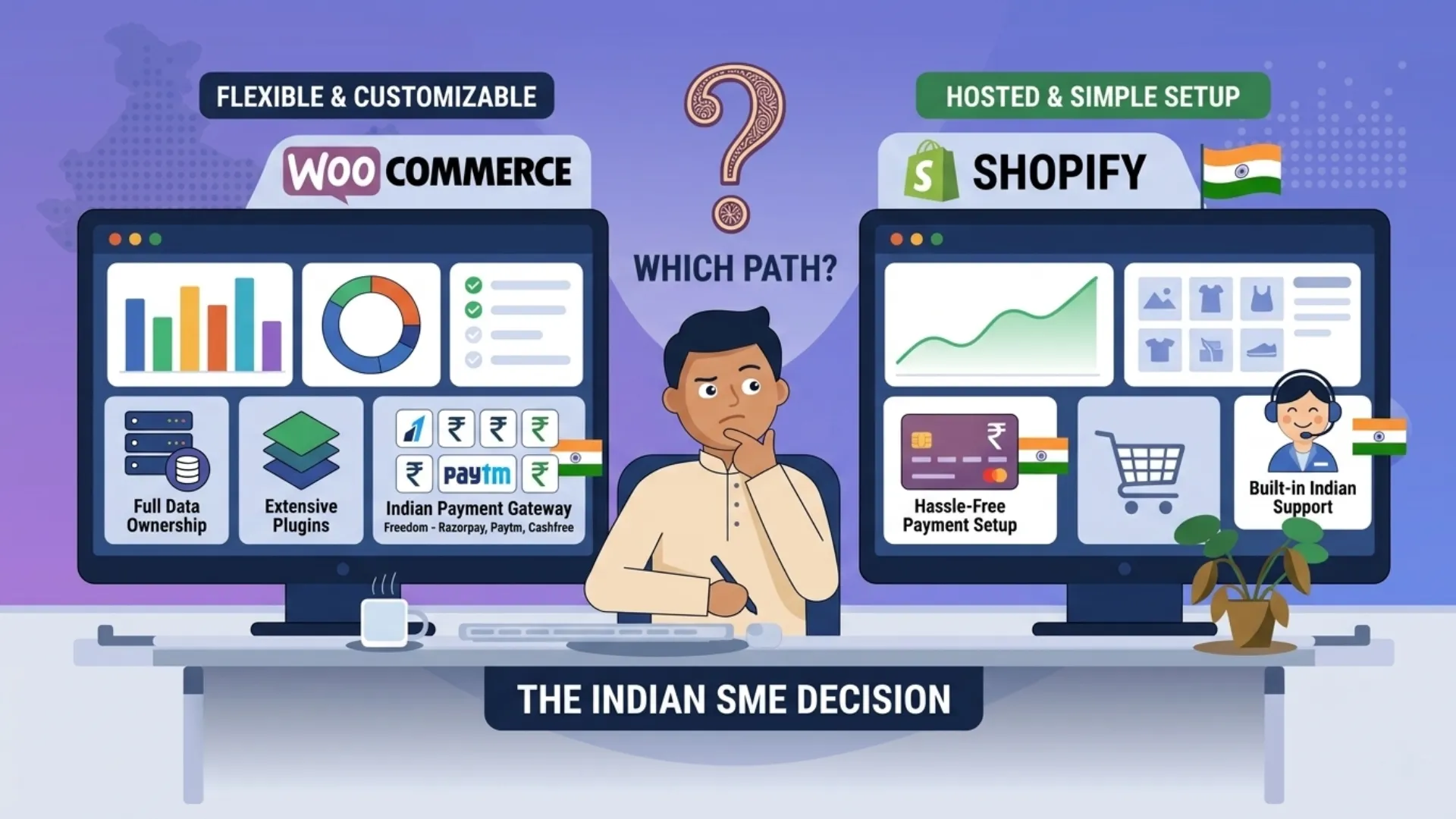
WooCommerce integrates cleanly with Razorpay, PayU, Cashfree, and other India-first gateways without transaction fee penalties. Shopify Payments is not fully available in India, which means most Indian merchants pay the additional 0.5–2% fee on third-party gateways regardless of plan tier – a cost WooCommerce avoids entirely.
Cash on delivery and local logistics
COD remains significant for Indian D2C sales. WooCommerce’s plugin ecosystem offers granular control over COD rules, regional restrictions, and integration with Indian logistics partners like Delhivery and Shiprocket. Shopify can do this too, but typically requires paid apps to match the same depth of control.
Content and SEO for the Indian market
If your growth strategy relies on organic search and content – which matters more in price-sensitive Indian markets where customers research extensively before buying – WooCommerate’s WordPress foundation gives a stronger blogging and technical SEO base than Shopify’s more limited content tools.
Neither platform is universally better. WooCommerce currently powers roughly 36% of e-commerce sites worldwide; Shopify holds around 28% but converts at a notably higher rate per merchant. The right choice depends entirely on your operational capacity – not on which platform has more market share.
A simple way to decide
Choose WooCommerce if:
- You want full ownership of your store, code, and customer data
- Content marketing and SEO are core to your growth strategy
- You sell complex or highly customised products that need bespoke logic
- You have access to ongoing technical support – internal or outsourced
Choose Shopify if:
- You want to launch quickly with minimal technical setup
- You plan to sell both online and in-person through POS
- You prefer predictable monthly costs over variable plugin and hosting expenses
- You don’t have ongoing technical resources to manage updates and security
The decision matters less than what comes after it
Whichever platform you choose, the platform itself is only the starting point. A WooCommerce store with no ongoing maintenance accumulates security risk and technical debt. A Shopify store with no strategic oversight on apps, fees, and performance still bleeds margin over time.
At Milliard Infotech, we manage stores on both platforms – which means our recommendation is based on what fits your business, not on which platform we happen to specialise in. We help SMEs choose the right platform upfront, then manage it on an ongoing, accountable basis.
Not sure which platform fits your business? We offer a free 20-minute consultation to walk through your specific requirements at milliardinfotech.com.