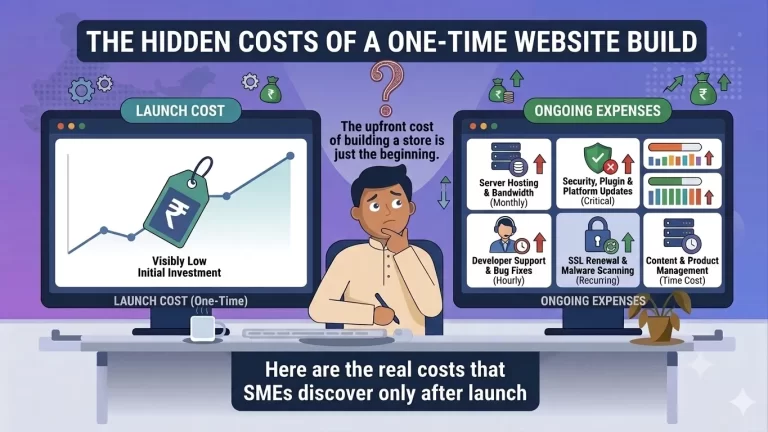
Most business owners think the hard part of e-commerce is building the store. It isn’t. The hard part is keeping it running – securely, reliably, and efficiently – month after month. Here’s why that distinction matters more than most people realise.
The “build and forget” problem
When a business decides to launch an online store, the focus naturally goes to the build: design, products, payment gateway, launch. A developer is hired, the store goes live, and the work is considered done.
For a few weeks, maybe even months, this works fine. But then things start to go wrong – quietly, in ways that don’t always show up immediately.
A plugin update breaks the checkout. The site slows down because the hosting plan was never optimised for real traffic. A security vulnerability appears and nobody patches it because the original developer moved on. Orders come in but the notification emails stop working.
None of these are dramatic failures. They’re slow leaks. And most SME owners don’t notice them until they’ve already cost money.
What “management” actually means
E-commerce management is not the same as e-commerce development. A developer builds a system. A manager keeps it operational.
In practical terms, ongoing management covers things like:
- Keeping WordPress, WooCommerce, and plugins updated — without breaking the store in the process
- Monitoring server uptime and site performance on a continuous basis
- Running regular security scans and responding to threats before they become incidents
- Backing up store data at regular intervals so recovery is fast if something goes wrong
- Testing critical flows — cart, checkout, payment — to catch issues before customers do
- Making ongoing optimisations to improve speed, conversion, and operational efficiency
This is not glamorous work. But it is what keeps a store generating revenue instead of headaches.
Think of it this way: you wouldn’t build a factory, hire someone to run it for three months, and then expect it to operate on its own indefinitely. An e-commerce store is infrastructure. Infrastructure requires ongoing operations.
Why most SMEs end up in a bad position
The typical SME e-commerce journey looks like this: a freelancer or small agency builds the store for a fixed fee. The engagement ends. The business owner is left managing the store themselves – or calling the developer every time something breaks, paying ad-hoc rates for every small task.
1. No accountability
When there is no ongoing engagement, there is no one responsible for what happens next. If the site goes down at 2am on a Friday, there is no SLA, no support commitment, no one to call.
2. Unpredictable costs
Ad-hoc development is expensive and hard to budget for. A “small fix” can turn into a day of work. A security incident can cost far more. Subscription-based management converts this unpredictability into a fixed monthly cost.
3. Technical debt builds silently
Without regular maintenance, stores accumulate outdated plugins, unoptimised databases, slow load times, and security gaps. None of these show up obviously in day-to-day use – until they do, usually at the worst possible moment.
What structured e-commerce management looks like
A well-managed e-commerce store operates under a defined framework: clear scope, defined responsibilities, regular reporting, and a single point of accountability.
At Milliard Infotech, this is exactly what we provide. We do not sell websites. We operate e-commerce systems on behalf of SMEs and D2C brands – on WooCommerce and Shopify – through a subscription-based model with formal service commitments.
Every client engagement includes:
- Store setup and configuration (for new stores) or system audit and handover (for existing ones)
- Hosting, security, and performance management
- Ongoing maintenance, updates, and issue resolution
- Monthly reporting and performance visibility
- A single team responsible for everything – no vendor coordination required
The goal is not to build something and move on. The goal is to make your store more stable, more efficient, and more reliable every single month.
Is this right for your business?
This model is designed for businesses that treat e-commerce as a core function – not a side project or an experiment. If you are an SME or D2C brand that is serious about building a stable online channel, and you want one accountable partner managing it long-term, our engagement model is worth exploring.
If you are looking for a one-time website build or a cheap freelancer for occasional fixes, we are not the right fit – and we would rather say that upfront than waste your time.