Most SME store owners have never seen an SLA. Their support arrangement is informal – a developer on WhatsApp, a hosting ticket system, a number to call when things go wrong. This works until it doesn’t. Here is what a proper service-level agreement covers and why it matters more than most people realise.
What an SLA is — and what it isn’t
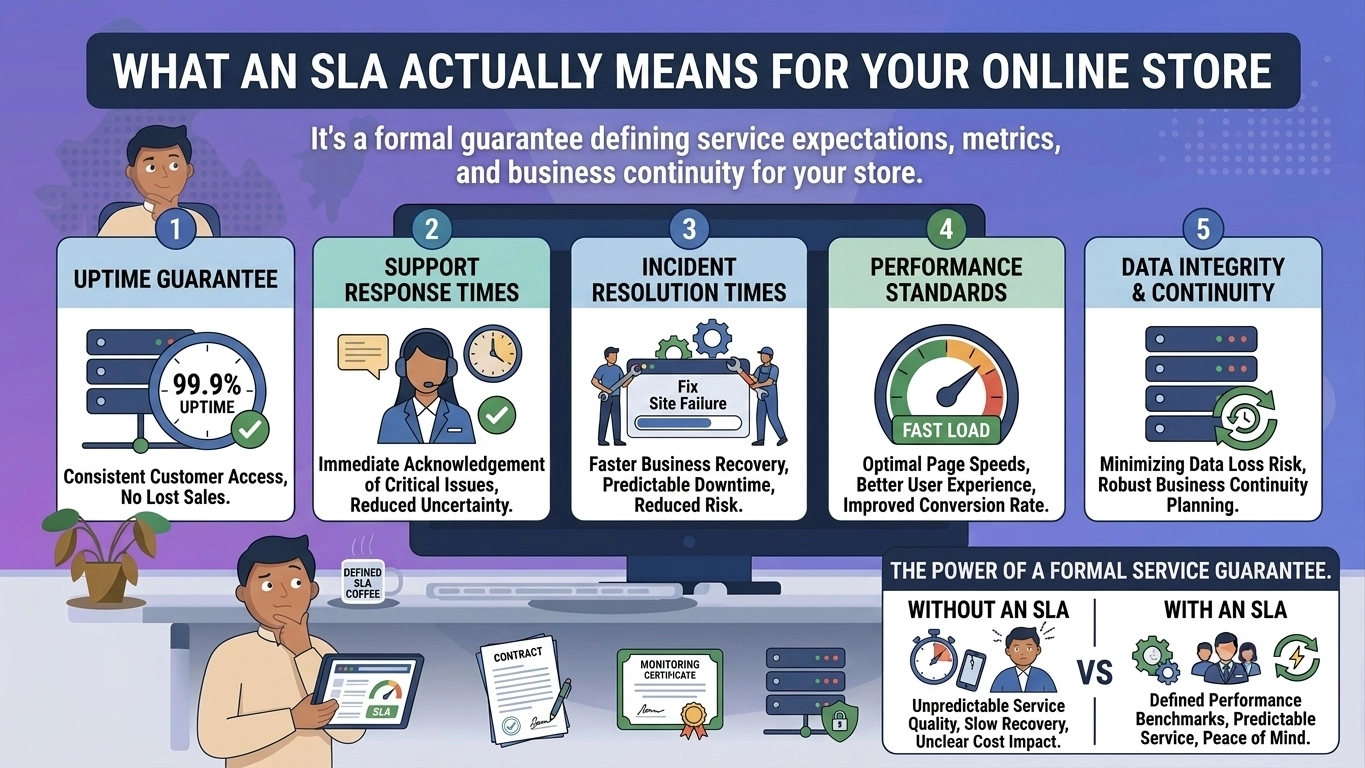
A service-level agreement is a written commitment between a service provider and a client that defines the standard of service to be delivered, how it will be measured, and what happens when it isn’t met. In the context of an e-commerce store, it is the document that answers the question: ‘If something goes wrong with my store, what exactly am I entitled to, and by when?’
What an SLA is not: a vague promise of ‘support’, a WhatsApp number, or a clause in a web development contract that says ‘we will be available for maintenance’. Those are intentions. An SLA is a commitment – with defined scope, defined timelines, and defined consequences.
The difference matters when something breaks on a Saturday evening and your developer does not respond until Tuesday.
With an SLA versus without one
| What happens when… | With a formal SLA | Without one |
|---|---|---|
| Response time | Defined SLA (e.g. 2 hrs for critical) | Call the developer and hope they pick up |
| Uptime commitment | Stated percentage with monitoring proof | Unknown – no monitoring in place |
| Scope of cover | Written, agreed, referenced in contract | Informal – varies by developer mood |
| Escalation path | Clear steps for critical incidents | None – you improvise under pressure |
| Reporting | Monthly performance and activity reports | Nothing, unless you specifically ask |
| Accountability | Contractual obligation with recourse | Good will only – no formal recourse |
The six terms in a good SLA, explained plainly
Most SLA documents are written in formal language that obscures what they actually commit to. Here is what each key term means in plain English for an e-commerce store owner.
1. Response time
How quickly the service provider acknowledges a reported issue. This is not the resolution time – it is the time between you raising a problem and someone confirming they have seen it and are acting on it. A well-structured SLA will define different response times for different severity levels: critical (store is down), high (checkout is broken), medium (intermittent errors), and low (cosmetic issues).
2. Uptime guarantee
The percentage of time your store is expected to be accessible and operational. 99.9% uptime sounds excellent until you calculate that it permits roughly 8.7 hours of downtime per year. 99.5% permits over 43 hours. The number matters less than what the SLA says happens when that threshold is breached – and whether it is being monitored independently so both parties have honest data.
3. Scope of coverage
Exactly what is and is not covered under the agreement. A vague scope is the most common source of disagreement in managed service relationships. A solid SLA defines covered services (e.g. plugin updates, security monitoring, backup management) and explicitly excludes others (e.g. new feature development, design changes, third-party integrations) so there is no ambiguity when something goes wrong.
4. Severity classification
A framework for categorising how serious a problem is, so response and resolution targets are proportionate. A store that is completely inaccessible warrants a different response than a product image not loading on one page. Without a severity classification system, every problem is treated at the same priority – which means critical ones can be delayed by minor ones.
5. Escalation procedure
What happens when an issue cannot be resolved within the standard response window, or when a critical incident requires senior attention. An escalation procedure defines who is contacted, when, and what authority they have to act. Without it, a critical incident at 11pm on a Friday becomes an improvisation exercise.
6. Reporting cadence
How often and in what format the service provider communicates store performance, maintenance activity, and any incidents. Monthly reporting is the minimum standard. Good reporting covers uptime data, security scan results, updates applied, issues encountered and resolved, and any recommendations for the coming period.
A well-written SLA protects both parties – not just the client. It gives the service provider a clear scope to work within and prevents scope creep, miscommunication, and disagreements about what was and wasn’t covered. If your current provider resists putting an SLA in writing, that itself tells you something important.
What questions to ask before signing a managed service agreement
If you are evaluating a managed e-commerce provider, these are the specific questions that reveal whether their SLA is substantive or decorative:
- What is the response time for a P1 (store-down) incident, and is it guaranteed 24/7 or only during business hours?
- How is uptime measured, and can I see the monitoring data independently?
- What is explicitly excluded from the SLA scope – and what happens if something outside scope causes an incident?
- How are incidents escalated if the first-line response cannot resolve the issue?
- What reporting will I receive, and how often?
- What happens – contractually – if SLA targets are consistently missed?
If a provider cannot answer these questions clearly and in writing, the SLA offers no real protection.
What Milliard Infotech’s SLA covers
Our managed operations engagements are built on a formal service commitment – not a verbal understanding. Every client receives a written SLA that covers:
- Defined response times by incident severity, including out-of-hours critical response
- Uptime monitoring with client-accessible reporting
- Monthly maintenance reporting covering updates applied, security scans, backup verification, and performance metrics
- A written scope of services with clear exclusions so there is never ambiguity about what is included
- A named escalation path for critical incidents
We manage both WooCommerce and Shopify stores under this framework – for SMEs and D2C brands that need an accountable operational partner, not another informal arrangement.
If you would like to review what a structured SLA looks like for your type of store,speak to us at info@milliardinfotech.com. We are happy to walk through our standard agreement before any commitment is made.