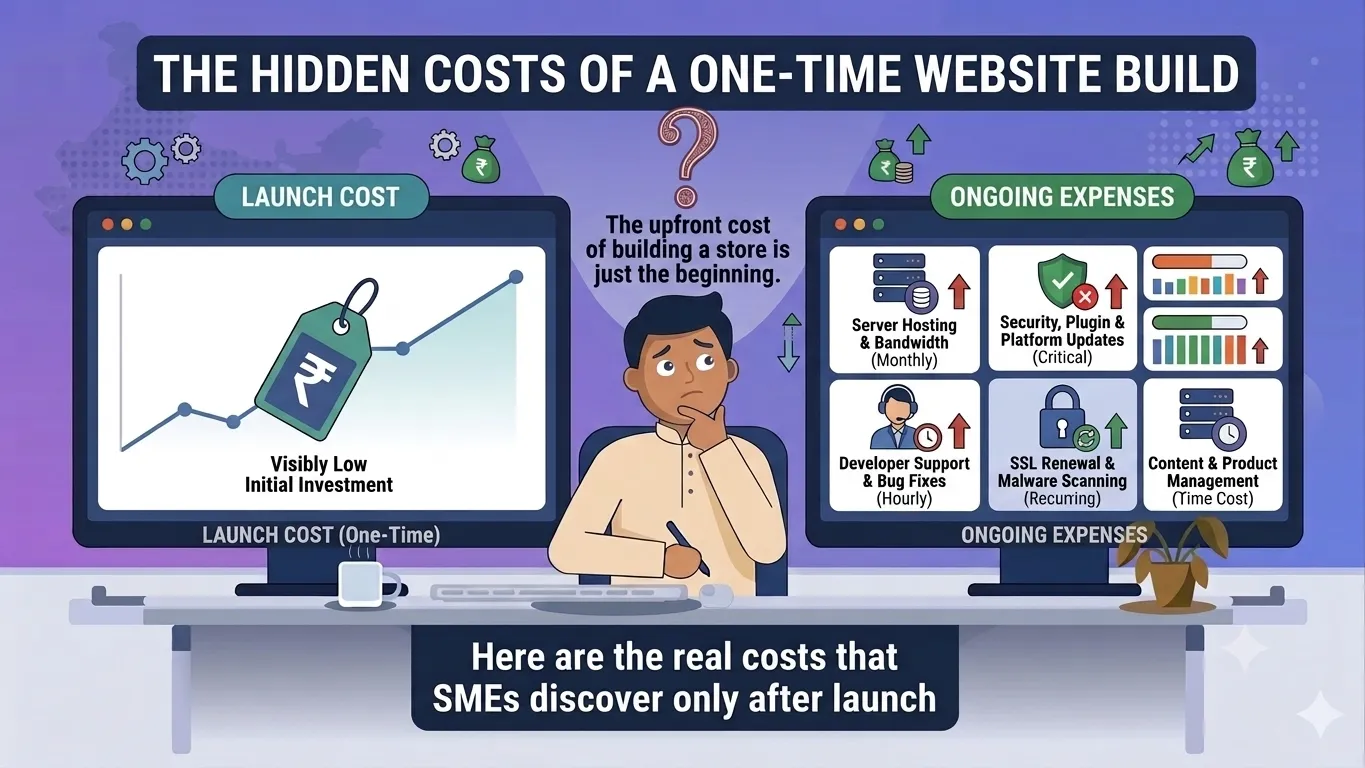
The invoice for building your e-commerce store felt like the big spend. It wasn’t. For most SMEs, the real cost of running an online store is what comes after the build – and nobody in the original contract told you about it.
Why the build cost is the wrong number to focus on
When a business commissions an e-commerce store, the decision typically centres on the build cost. How much does the design cost? What does development charge? How much is the WooCommerce setup or Shopify theme?
These are the wrong questions – or at least, incomplete ones. A store is not a finished product. It is a live, operational system that requires continuous maintenance to remain secure, fast, and functional. The build cost covers the initial construction. Every cost that comes after it is invisible in the original quote.
Most SME owners discover this six to twelve months after launch, when something goes wrong and they call the original developer back – at full ad-hoc rates, with no SLA, and no guarantee of availability.
The seven costs nobody puts in the proposal
| Cost item | Typical range | What actually happens |
|---|---|---|
| Plugin & extension updates | ₹0–₹5,000/year | Free plugins become paid; premium licences renew annually |
| Security & malware cleanup | ₹8,000–₹40,000 | Per incident cost, not annual — a single hack can exceed this |
| Developer fixes (ad-hoc) | ₹2,000–₹8,000/hr | Every small change is billed at project rates; no SLA |
| Hosting upgrade | ₹3,000–₹18,000/yr | Shared hosting fails under real traffic; upgrades are reactive |
| SSL certificate renewal | ₹800–₹5,000/year | Often forgotten until the browser shows a warning page |
| Performance fixes | ₹10,000–₹50,000 | Speed degradation requires developer intervention over time |
| Data recovery after failure | ₹15,000–₹1,00,000 | Backup restoration without prior testing often goes wrong |
The three failure patterns that repeat most often
1. The plugin trap
WooCommerce stores run on plugins. Plugins require updates. Updates sometimes break things. Without someone who understands the store’s full plugin stack reviewing updates before applying them, a routine update to WooCommerce core, a payment gateway plugin, or a caching tool can silently break checkout – sometimes for days before anyone notices.
The cost of the fix is never the issue. The cost of the lost orders during the downtime is.
2. The security incident
Unpatched WordPress installations are systematically targeted by automated bots. A store running on an outdated plugin version or an unmaintained PHP environment is not a matter of if it gets targeted – it is a matter of when. The average cost to clean a hacked WordPress site in India ranges from ₹8,000 to ₹40,000 depending on severity, not counting the potential loss of customer data and the reputational damage that follows.
The original developer’s build cost included no security monitoring and no incident response. It was never part of the scope.
3. The performance drift
A store that loaded in 2.1 seconds at launch may load in 4.8 seconds eighteen months later – without anyone making a single change. Database tables accumulate uncleared data. Image libraries grow without compression. Plugin bloat adds up. Hosting infrastructure that was adequate at launch no longer matches the store’s actual load.
Performance drift is invisible until it starts affecting conversion rates. By then, diagnosing and fixing it requires developer time that was never budgeted.
What the true cost of ownership actually looks like
Across a typical three-year period, an SME running an unmanaged WooCommerce store will spend:
- ₹15,000–₹60,000 in ad-hoc developer fixes and updates
- ₹8,000–₹40,000 responding to at least one security incident
- ₹10,000–₹30,000 in emergency performance or hosting upgrades
- An unmeasured amount in lost revenue from downtime they did not know was happening
None of this appears in the original build invoice. All of it is avoidable with structured management.
The question to ask is not ‘how much does a build cost?’ but ‘what does it cost per year to keep this store operational, secure, and commercially effective?’ For most SMEs, that number is significantly higher than they expect – and significantly lower with proper management in place.
What structured management changes
A subscription-based managed e-commerce model replaces all of the above with a single, predictable monthly cost. Milliard Infotech’s engagement model covers:
- Plugin and core updates reviewed and tested before deployment
- Continuous security monitoring and proactive vulnerability patching
- Regular database optimisation and performance checks
- Verified, tested backups with defined recovery procedures
- Uptime monitoring with response commitments under a formal SLA
- A single point of accountability – not a developer you have to chase
The monthly cost is fixed. The surprises are not.
If you would like to understand what ongoing management would cost for your store versus what you are currently spending on ad-hoc fixes, speak to us at info@milliardinfotech.com The comparison is usually straightforward.